 11
11
In the world of interior design, trends come and go with dizzying speed. One year, it’s all about matte black fixtures; the next, brass is back. However, true luxury is not about chasing the latest fad. It is about creating a space that feels sumptuous, serene, and enduring—a room that will look as sophisticated in a decade as it does today.
When we search for luxury bathroom design ideas online, we are often flooded with images of high-tech Japanese toilets, solid marble saunas, and gold-plated faucets. But timeless luxury is a different beast entirely. It is subtle. It is architectural. It whispers rather than shouts.
This guide will walk you through the principles of crafting a bathroom that exudes elegance without relying on “of-the-moment” gimmicks. From spatial planning to material selection, here is how to build a sanctuary that will never go out of style.
Before you pick out a single tile or faucet, you must understand that true luxury is built into the bones of the room. Decorative items (towels, candles, vases) are the jewelry of the space, but the architecture is the body.
The human eye finds symmetry inherently pleasing and regal. Look at classical French or Roman architecture; everything is mirrored. To achieve this in a luxury bathroom design:
Double vanities should be identical mirrors of one another.
Wall-mounted faucets should align perfectly with the center of each sink.
Windows should be centered over tubs or placed symmetrically on either side of a focal point.
Every great room has a hero piece. In a bathroom, this is usually the freestanding tub or a expansive walk-in shower. Do not clutter the room with equal attention to five different elements. If you have a stunning stone soaking tub, let it sit alone on a pedestal of marble. Do not put a bulky cabinet next to it.
Luxury requires breathing room. If your ceiling is standard height, use vertical paneling or floor-to-ceiling curtains (yes, even in a bathroom) to draw the eye up. If you have the budget, vault the ceiling or add a skylight directly over the shower. The volume of air in the room is just as important as the objects in it.
Trendy bathrooms often feature “millennial pink” walls or deep navy vanities. While beautiful, these colors date a room to a specific era. Timeless luxury bathroom design relies on a neutral, natural palette.
Stick to colors found in nature: warm whites, creams, soft greiges, charcoal, and earthy browns. Avoid stark whites (which feel clinical) and overly vivid jewel tones (which feel theatrical).
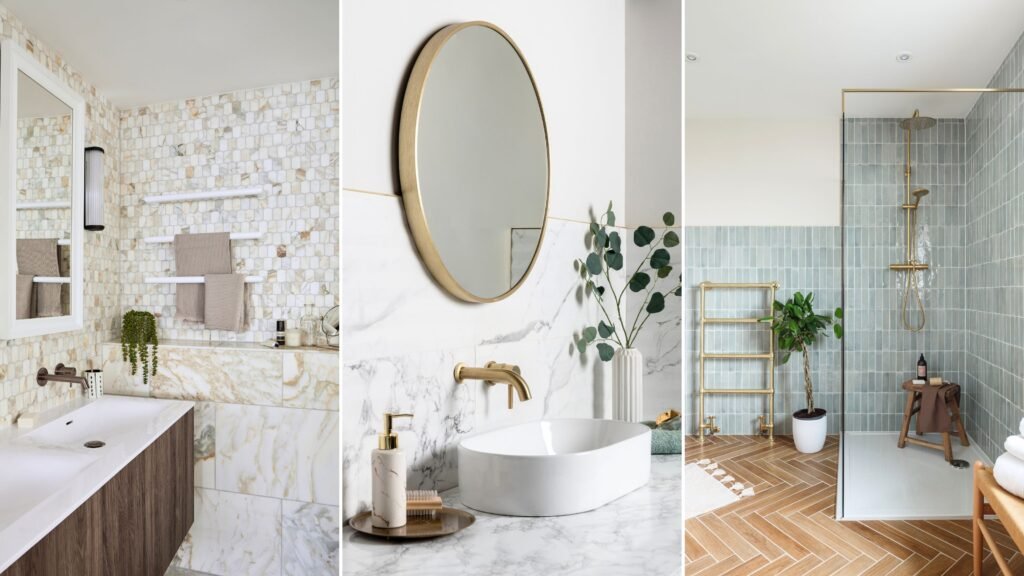
Walls: Lime wash, Venetian plaster, or large-format marble slabs. Texture is more important than color here.
Vanities: Stained walnut, white oak, or painted in a soft “greige” (gray/beige) like Farrow & Ball’s Purbeck Stone.
Fixtures: Polished nickel, unlacquered brass (which ages and patinas), or chrome. Avoid: Matte black (shows water spots and feels very 2010s) and rose gold (too specific to the 2020s).
The difference between a standard bathroom and a luxury one is the lighting plan. You need three layers:
Ambient: Soft recessed lights on a dimmer switch. Do not put a bright LED can light directly over the tub; place it in the corners.
Task: Sconces mounted at eye level (40-48 inches from the floor) on either side of the mirror. This eliminates shadows on the face. Never use an overhead light alone for shaving or makeup.
Accent: Picture lights above artwork, or LED strips tucked under the floating vanity to make the floor look weightless.
One of the most critical aspects of luxury bathroom design is knowing where to spend your money and where to save. Timeless materials are those that improve with age or remain impervious to trends.
1. Stone (Marble, Limestone, or Soapstone)
Yes, marble etches. Yes, limestone is porous. But that is the point. In a timeless luxury home, patina is not a flaw; it is a narrative. Honed or leathered finishes hide water spots better than polished.
Use: Flooring, shower walls, vanity countertops.
Avoid: Small mosaic tiles on the floor (too busy). Use large slabs or 24×24 inch tiles with minimal grout lines.
2. Solid Wood
Veneered plywood has its place, but solid wood vanities and shelving offer a heft that cannot be faked. White oak and walnut are classics. Use marine-grade varnish to protect against humidity.
3. Metal
Polished nickel is the king of timeless bathroom fixtures. It is warmer than chrome but cooler than gold. It looks expensive without being ostentatious. For a more rustic luxury, use unlacquered brass that will slowly darken to a deep honey brown.
Porcelain tile that mimics concrete or stone is acceptable for secondary walls or heated floors.
Quartz (engineered stone) is fine for a guest bathroom countertop if you hate maintenance, but avoid busy patterns that look fake.
A luxury bathroom design is defined by how the room functions. Luxury is not just looking good; it is feeling good. If a faucet drips or a shower has low pressure, all the marble in the world cannot save it.
Do not build a deck around a tub. A true timeless tub sits independently. Look for classic shapes:
Double slipper: High back on both ends (very Victorian).
Roll-top with claw feet: Traditional and formal.
Japanese soaking tub (Ofuro): Deep and square; minimalistic yet ancient.
Material: Cast iron (heavy, holds heat) or solid stone resin.
Forget the flimsy glass doors with metal frames that rust. Luxury now (and forever) leans toward either:
The Wet Room: The entire bathroom floor gently slopes to a central drain. A glass panel (no door) blocks splashes, but the room is open. This feels like a spa.
Frameless Glass: A single 12mm thick sheet of glass held by hinges. No metal frame. No rubber gaskets. Just crystal clarity.
A single-lever faucet is utilitarian. A thermostatic valve is luxury. You set the temperature once (e.g., 101°F), and every time you turn it on, it hits that exact temp regardless of someone flushing a toilet elsewhere. Add a handheld slide bar and a rain head.
Radiant floor heating: Non-negotiable for stone floors. It dries the room, prevents mildew, and keeps your feet warm.
Heated towel rails: A classic ladder-style radiator. It serves two purposes (heating the room and drying towels) and looks sculptural.
The best luxury bathroom design often goes unnoticed because it works so seamlessly. These are the details that separate a “rich” bathroom from a “refined” one.
Nothing kills the vibe of a beautiful marble counter like a tangle of hairdryer cords. Install outlets inside the vanity drawers (pop-up charging stations) or retractable cords that disappear into the wall.
Do not use a wire caddy that rusts. Build a recessed niche into the shower wall. The timeless trick: Make the niche floor out of a single slab of stone that slopes slightly forward (so water runs off) and is flush with the tile (no lipping).
A timeless design respects human dignity. The toilet should be in a separate “water closet” (a small room within the bathroom) with its own door, fan, and small window. If space prohibits that, a partial privacy wall or pocket door is essential.
A flat mirror is a wasted opportunity. Install a “medicine cabinet” that is recessed into the wall and hidden behind a beveled mirror. It gives you shaving cream storage without cluttering the vanity.
Luxury is tactile. The stone might be cold, but the towel is warm. The floor might be hard, but the bath mat is plush.
Turkish cotton (Peshtemal): Flat-woven, dries fast, gets softer with age.
Egyptian cotton (6-ply): Heavy, fluffy, and opulent.
Color: White or cream only. Colored towels fade unevenly and look dated. White towels can be bleached and look like a hotel every time.
Do not use a bath mat. Use a vintage Persian rug (washable wool) or a high-quality teak mat. A real rug grounds the room and adds a pattern that has existed for centuries, not just this season.
Bathrooms need art too. Avoid cliché “bathroom” prints (shells, boats, seascapes). Hang a real oil painting or a framed architectural drawing. Ensure it is sealed against humidity.
To ensure your luxury bathroom design remains timeless, avoid these “tells” of a trend-driven renovation:
LED color-changing lights: You are not a gaming PC. Stick to warm white (2700K).
Glass vessel sinks: Impossible to keep clean. Water splashes everywhere. They scream early 2000s.
Pebble tile floors: Those river rock floors trap dirt and are painful to stand on.
Mosaic “accent” strips: A random band of glass tile through the middle of your subway tile is the hallmark of a builder-grade renovation.
Smart toilets with exposed wires: If you want a bidet, get a concealed unit. Wires on the floor ruin the serenity.
A 2,000-word guide is not complete without a spatial guide. For a truly luxurious master bathroom, aim for these minimum dimensions:
| Element | Minimum Size for Luxury Feel |
|---|---|
| Shower (Wet room) | 36″ x 60″ (prefer 48″ x 72″) |
| Freestanding Tub | 60″ long x 30″ wide |
| Walkway between vanity & tub | 36″ (so you never bump elbows) |
| Water closet (toilet room) | 36″ x 60″ |
| Vanity height | 36″ (standard) or 42″ (comfort height) |
No, but it requires acceptance. Marble is calcium carbonate; it reacts with acidic products (toothpaste, perfume, face wash). If you want a perfect, shiny floor forever, do not use marble. If you want a beautiful, historic material that will develop a soft, matte patina over 20 years (called “character”), then marble is perfect. Seal it once a year.
Large-format Calacatta or Carrara marble slabs (minimal grout lines) or classic white 3×6 subway tile laid in a running bond with a dark grey grout. Subway tile has been used for over a century and will never look dated.
Focus on scale and light. Use a pedestal sink instead of a bulky vanity to make the floor visible (makes the room feel bigger). Install a large mirror that goes almost edge-to-edge. Use a frameless glass shower door. Paint the ceiling the same color as the walls to blur the boundaries.
No. However, specific shapes are. The egg-shaped tub (very 2015) is fading. The classic roll-top and the stark rectangular soaking tub (like a stone trough) are eternal. Avoid tubs with jets (jetted tubs are hard to clean and feel dated). Stick to a simple soaking tub.
Polished nickel and unlacquered brass are the current kings of luxury bathroom design. Chrome is also making a quiet comeback because it is classic, cheap, and easy to clean. If you want something dark, look for “oil-rubbed bronze” (a dark brownish-copper) rather than flat black.
If you share the bathroom with a partner, a double vanity is more functional and timeless. However, if space is tight, one long vanity with one sink and a large empty counter (dressing table style) is actually more luxurious than two tiny sinks crammed together. Give each person their own storage tower, even if they share a sink.
Texture and wood. Add a teak stool, a natural woven basket for laundry, and a linen curtain. Warm lighting (2700K) on a dimmer switch is the cheapest way to make stone look cozy. Avoid stark white grout; use warm grey or beige grout.
Yes, if it is fully tiled (floor to ceiling) with a bench and a proper steam generator. However, it is a complex mechanical system that will eventually break. For pure timelessness, a rain shower with a hand sprayer is simpler and less likely to fail. Only install a steam unit if you are sure you will use it twice a week.
Yes, but you need a rule. The classic rule of thumb: Pick one hero finish for your water-bearing fixtures (faucets, shower heads) and a secondary finish for your hardware (cabinet pulls, towel bars). Example: Polished nickel faucets + unlacquered brass cabinet pulls. Do not use three or four finishes.
The lighting dimmer. For $20, you turn your clinical bathroom into a spa. When you take a bath, dim the lights to 20%. When you shave, turn them to 100%. Luxury is control over your environment. No bathroom feels luxurious under harsh, full-brightness LEDs.