 11
11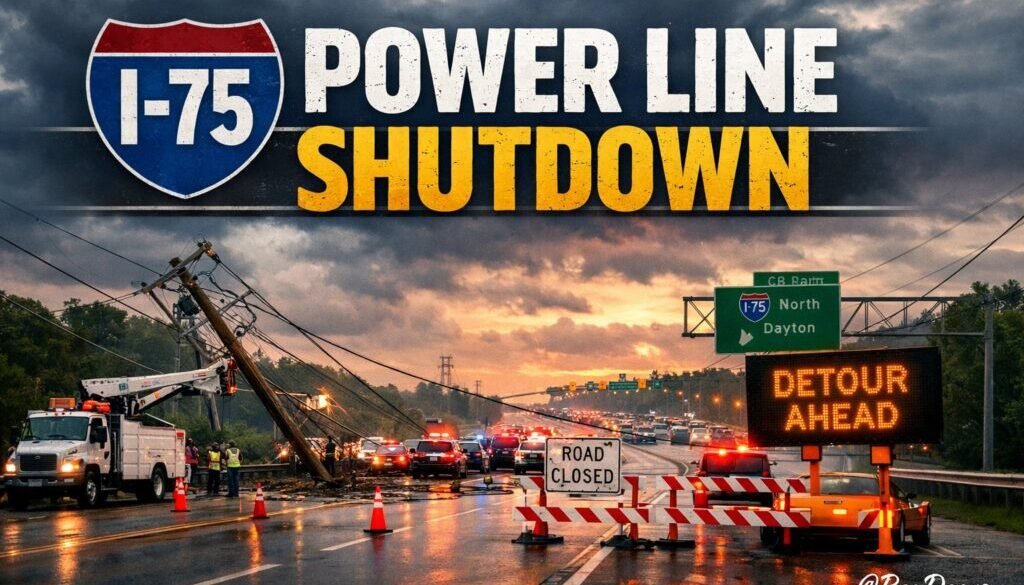
Interstate 75 stretches over 1,700 miles from Miami, Florida, to Sault Ste. Marie, Michigan, serves as one of America’s most vital north-south transportation corridors. When power lines fall across this major artery, the result is not merely an inconvenience—it becomes a complex safety emergency requiring coordinated responses from utility crews, law enforcement, and transportation departments. This article examines the causes, timelines, and impacts of I-75 power line shutdowns, with particular focus on recent events that have disrupted travel across multiple states.
Power line shutdowns occur when electrical infrastructure intersects with highway safety. High-voltage transmission lines carry enough electricity to cause fatal injuries on contact. When a line falls across a roadway—whether due to severe weather, vehicular accidents, or structural failure—first responders must treat the area as a hazardous zone until utility professionals arrive to de-energize the lines.
The term “shutdown” refers to the complete halting of traffic in affected areas, allowing utility crews to work safely without risk to motorists. These events fall into two categories:
Emergency Shutdowns occur when lines are downed unexpectedly. Storms, vehicle collisions with utility poles, or equipment failures can trigger immediate closures that last anywhere from two to twelve hours or more.
Planned Shutdowns involve scheduled maintenance where utility companies coordinate with transportation departments to temporarily halt traffic while running new lines across highways or performing infrastructure upgrades. These typically occur during overnight hours to minimize disruption.
When a power line falls, the ground surrounding it can become energized, creating a hazard zone that extends well beyond the visible wire. Utility workers follow a strict protocol: they assume every line is live until personally verified as de-energized and grounded. Motorists must exercise the same caution—approaching downed lines or attempting to move them is potentially deadly.
On Wednesday, June 18, 2025, Interstate 75 experienced a significant power line shutdown in Vandalia, Ohio, located in Montgomery County. The incident began when severe thunderstorms swept through the region, knocking down a high-voltage transmission line across the interstate.
6:58 p.m. – The downed power line was reported to authorities. The Ohio State Highway Patrol confirmed that a high-voltage line had fallen across the highway near the Northwoods Boulevard exit.
Immediate Response – Both northbound and southbound lanes were closed between US-40 and Northwoods Boulevard. The Montgomery County administration identified the downed infrastructure as a high-tension three-phase power line—a critical piece of electrical infrastructure requiring specialized handling.
Traffic Impact – The closure created extensive backups. Northbound traffic stalled past the I-70 and I-75 interchange, while southbound congestion reached the Miami County line.
10:00 p.m. – AES Ohio crews completed repairs, and the Ohio State Highway Patrol confirmed the highway had fully reopened.
The total closure duration was approximately three hours—a relatively swift response given the complexity of high-voltage repairs.
The downed power line was directly attributed to thunderstorms passing through the Dayton area that evening. Strong winds likely caused the line to snap or pull it from its supporting structures, sending it across multiple lanes of traffic. The line was identified as a high-voltage transmission line, explaining why crews required significant time to safely de-energize and remove it.
AES Ohio dispatched crews immediately to the scene. Working in coordination with the Ohio State Highway Patrol and Montgomery County authorities, utility workers focused on de-energizing the line, assessing damage, and removing the hazard from the roadway. The three-hour response time reflected both the complexity of the work and the importance of ensuring complete safety before reopening.
A more extensive power line shutdown occurred in Monroe, Ohio, in April 2024. Severe storms with high winds broke six power poles north of Monroe in Butler County, taking down multiple transmission lines, distribution lines, and a telecommunication line. The initial incident closed both sides of I-75 for more than five hours on the night of April 2.
However, the full repairs required additional closures. Duke Energy scheduled follow-up work for May 5-6, 2024, implementing four rolling stops each night from 11 p.m. to 4 a.m. These 15-minute closures allowed crews to pull new power lines across the highway and complete final replacements of storm-damaged equipment.
This incident illustrates that power line shutdowns often require multiple phases of work. Initial emergency repairs may restore traffic flow, but permanent infrastructure replacement can necessitate subsequent planned closures.
In September 2025, westbound I-696 at I-75 in Oakland County, Michigan, closed due to a downed power line. DTE Energy crews responded by installing a new wire and pole, completing repairs before rush hour. This incident demonstrated how a timely utility response can minimize disruption to commuters.
A unique incident occurred in Flint Township when a vehicle snagged a power line, leading to the closure of both northbound and southbound I-75 at Bristol Road. Consumers Energy crews had to de-energize the line and cut it by hand. The interstate reopened approximately one hour after the initial call, though approximately 1,000 feet of power line required replacement, leaving 941 customers without power for several hours.
A contractor gathering soil samples near I-75 in Monroe County snagged overhead cables with equipment, causing damage that required two separate closures. The first repair involved a non-energized neutral power line, followed by a second closure for cable company repairs. This incident highlighted how construction or sampling work near highways can inadvertently trigger power line emergencies.
Power line shutdowns on I-75 create cascading traffic impacts that extend far beyond the immediate closure zone. During the June 2025 Vandalia closure, northbound traffic backed up to the I-70 and I-75 interchange, while southbound congestion reached the Miami County line—stretching several miles in each direction.
These backups affect not only interstate travelers but also local roads, as drivers seek alternative routes. Secondary roads in Vandalia and surrounding communities experienced increased traffic volumes, creating congestion for residents and businesses.
I-75 serves as a critical freight corridor, carrying trucks loaded with food, medical supplies, retail goods, and industrial materials. When the highway closes, commercial vehicles face difficult choices: sit idle waiting for reopening or take lengthy detours through small-town roads not designed for heavy truck traffic.
Each hour of delay translates to increased operational costs for trucking companies, including driver wages, fuel consumption, and missed delivery windows. Refrigerated trucks carrying perishable goods face particular pressure, as extended delays can result in spoiled inventory and financial losses.
Local businesses near closure zones experience mixed impacts. Gas stations and restaurants may see brief surges as stranded drivers exit the highway. However, extended closures reduce customer access, and employees who rely on I-75 for commuting may arrive late or miss shifts entirely.
The primary concern during any power line shutdown is public safety. Downed high-voltage lines pose electrocution risks to anyone who approaches them. First responders must secure the area and prevent motorists from exiting vehicles near fallen wires.
Additionally, stopped traffic on interstates creates secondary safety risks. Rear-end collisions, frustrated drivers attempting dangerous U-turns, and emergency vehicle access challenges all require careful management by law enforcement.
Successful power line shutdown management requires seamless coordination among multiple entities:
Utility Companies – AES Ohio, Duke Energy, DTE Energy, and Consumers Energy (depending on region) deploy crews to assess damage, de-energize lines, and make repairs. Their response time significantly impacts closure duration.
State Highway Patrol – Law enforcement officers secure the scene, redirect traffic, and establish detours. They also communicate closure information to the public and coordinate with neighboring jurisdictions.
Department of Transportation – State DOTs manage traffic cameras, electronic message boards, and 511 systems to alert motorists. They also establish official detour routes.
Local Government – County and municipal authorities assist with traffic management, public notifications, and coordination with utility crews.
Modern technology has transformed how authorities communicate about highway closures. State DOTs maintain 511 phone systems and websites providing real-time incident information. Navigation apps like Waze and Google Maps integrate official data feeds and user reports, allowing drivers to receive closure alerts and alternative route suggestions within minutes of an incident.
Electronic message boards along I-75 display closure information and detour directions, helping drivers adjust their routes before reaching congestion zones.
When approaching a power line closure, follow these safety steps:
Remain in your vehicle if a power line falls on or near your car. The rubber tires provide insulation from the ground.
Call 911 to report your location using mile marker numbers posted along I-75.
Follow instructions from law enforcement and utility crews. Do not attempt to turn around or drive over downed lines.
Only exit if the vehicle is on fire. If evacuation becomes necessary, jump clear without touching the vehicle and the ground simultaneously. Shuffle away with both feet together to avoid creating a path for electricity.
Lines sagging dangerously low—even if not on the ground—warrant immediate reporting. Safely pull over, maintain distance, and call 911 with the exact location.
Given I-75’s length and the potential for unexpected closures, drivers should maintain:
An emergency kit with water, blankets, flashlights, and non-perishable food
A portable phone charger or power bank
Adequate fuel—keeping the tank at least half full provides a buffer during extended delays
Offline maps downloaded in case of a poor cellular signal
Central Florida, particularly the corridor from Tampa to Ocala, receives more lightning strikes per square mile than almost anywhere in the United States. Lightning strikes on transmission towers can cause power surges, transformer damage, and falling debris—all of which may trigger highway shutdowns.
Major metropolitan areas like Atlanta and Detroit face different challenges. Vehicle collisions with utility poles represent a leading cause of power line shutdowns in urban settings. High traffic volumes mean even minor incidents can create congestion extending for miles.
Winter storms in Michigan and Ohio can bring ice accumulation on power lines, causing them to snap under the weight. Snow and ice also complicate repair efforts, potentially extending closure durations.
To stay informed about I-75 power line shutdowns and other disruptions, utilize these resources:
511 Systems – Available in most states along the I-75 corridor, providing automated traffic updates
State DOT Websites – Florida’s SmartWay, Georgia’s 511, Ohio’s OHGO, and Michigan’s Mi Drive offer live traffic cameras and incident reports
Navigation Apps – Waze and Google Maps aggregate official data and user reports for real-time rerouting
Local News – Stations in major I-75 cities provide coverage of significant closures
The frequency of power line shutdowns correlates with severe weather events. Spring and summer thunderstorms across the Midwest and Southeast, along with winter ice storms in northern states, create seasonal peaks in utility-related highway closures.
Utility companies have invested in infrastructure hardening—replacing wooden poles with steel or concrete, trimming vegetation near power lines, and implementing smart grid technologies—to reduce weather-related outages. However, the aging nature of much electrical infrastructure means power line incidents will likely continue affecting I-75 travel.
I-75 power line shutdowns represent the intersection of critical infrastructure—electrical grids and interstate highways—where safety demands outweigh convenience. Whether triggered by thunderstorms in Ohio, lightning in Florida, or vehicle accidents in Michigan, these events require coordinated emergency responses and patience from affected motorists.
The June 2025 Vandalia closure demonstrated that even relatively short incidents can create extensive traffic impacts. Understanding why these shutdowns occur, how authorities manage them, and what safety protocols to follow helps drivers navigate disruptions more effectively.
As utility companies modernize infrastructure and transportation agencies enhance communication systems, the duration and frequency of power line shutdowns may decrease. Until then, travelers on this vital corridor should remain informed, prepared, and patient—recognizing that each closure prioritizes the safety of everyone on the road.
Remain in your vehicle immediately. Turn on hazard lights and wait for instructions from emergency personnel. Do not attempt to turn around or drive over downed lines. If a power line falls on your vehicle, stay inside unless the car catches fire—the rubber tires provide crucial insulation from electrical current.
Duration varies significantly. Planned maintenance closures may last 15 minutes to an hour, often implemented in rolling stops. Emergency shutdowns typically require a minimum of 2 to 4 hours for de-energizing lines and basic clearance. If pole replacement is necessary, closures can extend to 6 to 12 hours or more.
No. Crossing law enforcement barriers is illegal and extremely dangerous. The hazard zone around downed power lines extends beyond visible wires—the ground itself may be energized. Always respect established perimeters.
No. Electric vehicles (EVs) provide the same insulation through rubber tires as conventional vehicles. However, first responders are trained to handle high-voltage systems in modern EVs, so inform emergency personnel if you are in one.
Use state 511 systems, Department of Transportation websites with live traffic cameras, and navigation apps like Waze or Google Maps. Local news stations also provide coverage of significant incidents.
Safety protocols require complete closure when any portion of a high-voltage line is down. The line could move, become re-energized, or create a hazard zone extending into travel lanes. Utility crews require space to work safely without passing traffic.
The state highway patrol typically initiates closures based on safety assessments, working in coordination with utility companies. For planned maintenance, utility companies coordinate with state Departments of Transportation to schedule closures during low-traffic periods.
Common causes include severe weather (thunderstorms, lightning, ice storms), vehicle collisions with utility poles, construction equipment snagging lines, structural failures of poles or towers, and fallen trees or branches during storms.
Prevention strategies include infrastructure hardening (replacing wooden poles with steel or concrete), vegetation management to prevent tree-related outages, regular inspections, and smart grid technologies that can isolate faults before they cause widespread failures.
Essential items include water, non-perishable food, blankets, flashlight, portable phone charger, first aid kit, and a full fuel tank. Offline maps provide navigation if cellular service is unavailable during extended delays.