 11
11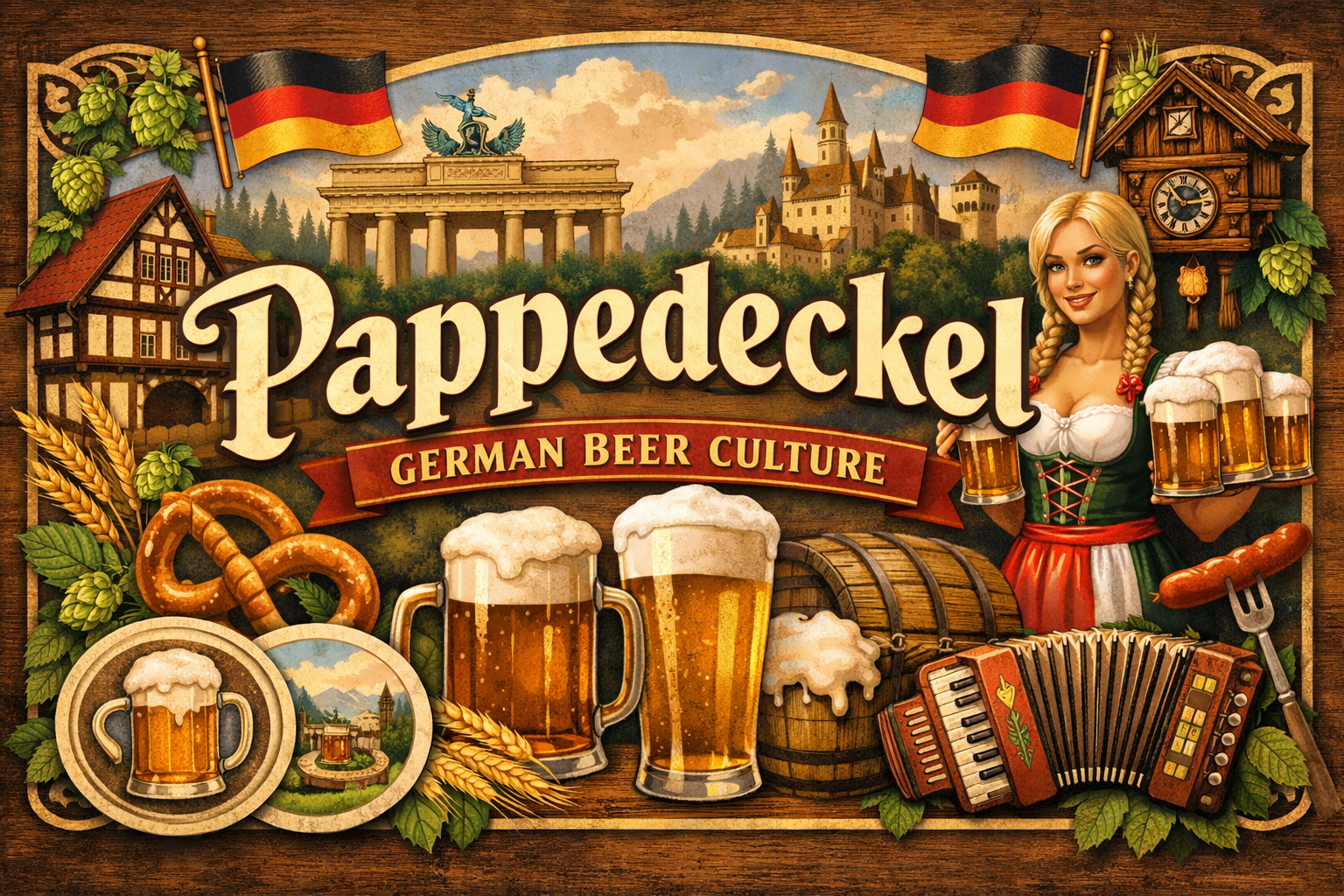
The Pappedeckel is far more than a simple piece of cardboard placed beneath a frothy glass of lager. In the bustling beer halls of Munich, the sun-dappled Biergärten of Bavaria, and the cozy Gaststätten scattered across Germany, the Pappedeckel has earned its place as a quiet yet unmistakable symbol of tradition, practicality, and national pride. Literally translating to “cardboard lid” from the German words Pappe (cardboard) and Deckel (lid or cover), the Pappedeckel has evolved from a humble protective accessory into a cultural phenomenon deeply intertwined with German beer heritage. This article explores the fascinating journey of how the Pappedeckel rose to prominence, tracing its roots, innovations, cultural integrations, and enduring legacy. Through centuries of refinement and adaptation, the Pappedeckel has become inseparable from the rituals of German beer drinking, representing both functionality and festivity in a way few other objects can match.
To understand the Pappedeckel’s ascent, one must first grasp its linguistic and practical beginnings. The term Pappedeckel emerged in German-speaking regions as a straightforward descriptor for any cardboard-based cover or coaster used with beverages. While the more common modern synonym Bierdeckel specifically highlights its beer-related purpose, Pappedeckel emphasizes the material itself—cardboard derived from compressed wood pulp. This distinction underscores the Pappedeckel’s versatility, extending beyond beer to everyday uses, yet its strongest association remains with Germany’s legendary beer culture.
Historically, the need for such an item arose in the 1800s during an era when beer consumption often took place outdoors or in open taverns. Insects, dust, and debris posed constant threats to open mugs. Wealthier patrons relied on heavy stoneware steins (Steinkrüge) fitted with hinged pewter lids that could be thumb-lifted for sipping. For the average drinker, however, simpler solutions prevailed. Early predecessors of the Pappedeckel included round felt pieces or cloth covers placed directly atop glasses to shield the contents. These “lids” were absorbent and reusable but suffered from poor hygiene; tavern owners rarely cleaned or dried them properly, leading to mold and unpleasant odors. The Pappedeckel concept—initially as a top cover rather than an under-coaster—addressed these issues by offering a disposable, practical alternative that kept beer pure while protecting tables from condensation rings.
In regional dialects, variations like Bierfoyzel or Fuizl (from the word for felt) persisted in Bavaria, reflecting the Pappedeckel’s folk roots. Over time, the shift from felt to cardboard marked a pivotal evolution, driven by industrialization and the growing emphasis on cleanliness in public drinking spaces. The Pappedeckel’s early forms laid the groundwork for its transformation into an icon, blending utility with the emerging commercialization of beer.
The true birth of the Pappedeckel as we know it today occurred in 1892, when Robert Sputh (sometimes spelled Spruth), a Dresden-born entrepreneur and owner of a paper mill in Mittelndorf near Radeberg, developed the first mass-producible cardboard version. Sputh engineered a process to press wood pulp into round molds, forming thick, absorbent discs known as Holzfilzplatten or fiber-cast coasters. These early Pappedeckel measured approximately 107 millimeters in diameter and 5 millimeters thick—dimensions that remain standard. Sputh patented his invention, recognizing its potential to revolutionize tavern service by replacing unhygienic felt with a clean, single-use product.
This innovation arrived at a perfect moment in German history. The Industrial Revolution had boosted beer production, with thousands of breweries operating under the strict Reinheitsgebot purity law of 1516. As beer halls expanded and outdoor Biergärten proliferated, the demand for reliable table protection soared. The Pappedeckel’s absorbency—thanks to the porous wood fiber structure—prevented water rings on wooden surfaces, stabilized heavy glassware, and reduced the clatter of mugs being set down. Suddenly, the Pappedeckel was not just a lid but a multifunctional tool that enhanced the entire drinking experience.
Sputh’s patent sparked immediate interest, but production remained somewhat cumbersome. The molded pulp process was labor-intensive and yielded inconsistent results in moisture resistance. Nevertheless, it planted the seed for the Pappedeckel’s cultural dominance, proving that even the simplest item could be engineered for widespread adoption in Germany’s vibrant beer scene.
Just eleven years later, in 1903, Casimir Otto Katz from the Murgtal region in the Black Forest perfected the Pappedeckel’s manufacturing. Katz, whose family had roots in paper production dating back centuries, introduced an industrial method using sheets of wood pulp derived from sustainable spruce fibers (Fichtenholz). Instead of molding pulp directly, his process involved pressing large sheets and punching out precise circular discs. This breakthrough dramatically improved efficiency, absorbency (due to the long, interlocking spruce fibers), and durability while slashing costs.
The Katz family company, still operating today from Weisenbach, now produces an astonishing 5 to 7 million Pappedeckel daily and supplies roughly 75 percent of the world’s beer coasters. Their dominance transformed the Pappedeckel from a novelty into a staple. Early versions were plain, but breweries quickly recognized the advertising potential. Logos, slogans, festival dates, and even humorous illustrations began appearing on the top surface, turning the Pappedeckel into a portable billboard. This marketing integration accelerated its rise as an icon, embedding specific brewery identities into everyday German life.
The Pappedeckel’s material purity—sourced from managed Black Forest forests—also aligned perfectly with Germany’s environmental ethos and beer purity traditions. No plastics or synthetics were involved, making the Pappedeckel an early example of sustainable packaging long before the term gained modern traction.
Initially conceived as a lid placed atop glasses to ward off flies and debris, the Pappedeckel gradually migrated beneath the mug. This shift reflected changing tavern practices: as glasses grew larger and tables more crowded, under-coaster placement proved more practical for stability and spill absorption. In traditional Kölsch houses in Cologne, for instance, servers carry trays of small 0.2-liter glasses and use the Pappedeckel to tally consumption. Each beer ordered earns a pencil mark or line on the coaster; at the end of the session, the total is calculated directly from the Pappedeckel. This ritual—unique to certain regions—elevated the Pappedeckel beyond functionality into a record-keeping artifact, fostering a sense of trust and camaraderie between guest and server.
In larger beer halls and Oktoberfest tents, the Pappedeckel serves multiple roles simultaneously. It levels wobbly tables, acts as a makeshift napkin for wiping foam, and even signals when a drinker has finished (by placing it atop the empty glass). Stacking or folding Pappedeckel became a casual pastime during long evenings, turning them into impromptu toys or conversation starters. The Pappedeckel’s quiet versatility cemented its status in daily German beer culture, where practicality meets social bonding.
By the early 20th century, the Pappedeckel had become a prime advertising vehicle. Breweries distributed millions featuring vibrant designs tied to seasonal events, regional festivals, and brand stories. A Pappedeckel from a Munich brewery might showcase the Paulaner logo alongside Oktoberfest motifs, while one from a small Franconian operation could highlight local heritage. This practice not only promoted sales but created emotional connections; patrons pocketed used Pappedeckel as souvenirs, carrying pieces of their beer experiences home.
Collecting Pappedeckel evolved into a dedicated hobby known as tegestology—the study and collection of beer coasters. Enthusiasts worldwide amass thousands, organizing them by brewery, year, or theme. Rare pre-World War II examples or limited-edition festival runs command high prices. Clubs such as the Brewery Collectibles Club of America and European equivalents foster this passion, with the Pappedeckel serving as tangible memorabilia of German beer culture’s global reach. The Pappedeckel’s collectibility further solidified its iconic status, transforming disposable cardboard into cherished artifacts.
No setting showcases the Pappedeckel’s cultural prominence more vividly than Germany’s iconic Biergärten and Oktoberfest celebrations. Under chestnut trees in Munich’s Englischer Garten or amid the massive tents of the Wiesn, millions of Pappedeckel support towering Maßkrüge of golden lager. They withstand constant use, absorbing condensation from chilled glasses while bearing the logos of the six official Oktoberfest breweries. The Pappedeckel’s presence reinforces the festive yet orderly atmosphere—protecting tables, enabling efficient service, and adding a layer of authenticity to the experience.
In private homes and smaller pubs, the Pappedeckel remains mandatory. German households often keep stacks on hand to prevent rings on wooden furniture, reflecting a national aversion to mess during social gatherings. The Pappedeckel has even entered popular culture through jokes, songs, and literature, where it symbolizes unpretentious enjoyment. Its role in tallying drinks, especially in the rapid-service Kölsch tradition, underscores a deeper cultural value: transparency and fairness in hospitality.
In an age of environmental awareness, the Pappedeckel’s natural origins have propelled its resurgence. Made entirely from renewable spruce pulp sourced from sustainably managed forests, the Pappedeckel is fully biodegradable and recyclable. Unlike plastic alternatives, it leaves no micro-waste, aligning perfectly with Germany’s green policies and the beer industry’s commitment to tradition. Modern manufacturers continue to innovate, producing thicker, more absorbent variants or those with special coatings for longer-lasting prints, all while maintaining the Pappedeckel’s core eco-friendly profile.
Today’s Pappedeckel also appears in creative applications beyond beer—on takeaway coffee cups, salad bowls, and even as promotional items at non-alcoholic events—yet its heart remains in German beer culture. Breweries emphasize the Pappedeckel in sustainability campaigns, highlighting how a simple cardboard disc supports both heritage and planetary health.
German immigrants carried the Pappedeckel concept to the United States, particularly Texas and the Midwest, where breweries like those in the Hill Country adopted it during the late 19th century. American craft beer scenes have embraced the Pappedeckel, with many taprooms importing authentic German versions or producing domestic replicas. International festivals from Brazil’s Oktoberfest in Blumenau to Australia’s beer expos feature Pappedeckel prominently, introducing new generations to this icon.
The Pappedeckel’s global journey illustrates cultural export at its finest: a humble object that carries the spirit of German Gemütlichkeit—warmth, conviviality, and precision—wherever beer is celebrated.
From its rudimentary felt ancestors to Sputh’s 1892 patent and Katz’s 1903 industrial triumph, the Pappedeckel has steadily ascended to become an indispensable emblem of German beer culture. It protects, advertises, tallies, collects, and connects people across generations and continents. In every clink of a glass, every mark of a server’s pencil, and every souvenir tucked into a pocket, the Pappedeckel quietly affirms the values of quality, community, and sustainability that define Germany’s brewing heritage.
Whether you encounter a Pappedeckel in a historic Munich beer hall or a modern craft brewery abroad, its presence evokes centuries of tradition. The Pappedeckel is not merely functional—it is iconic, a cardboard testament to the enduring joy of sharing a perfectly poured beer. As long as Germans raise their glasses in toast, the Pappedeckel will remain right there beneath them, a small but mighty symbol of a rich cultural legacy.
What exactly is a Pappedeckel? A Pappedeckel is the German term for a cardboard beer coaster or lid, literally meaning “cardboard cover.” It is typically round, absorbent, and placed under beer glasses to protect tables, absorb condensation, and provide stability.
When was the Pappedeckel invented? The modern cardboard Pappedeckel was invented in 1892 by Robert Sputh in Dresden using pressed wood pulp. It was significantly improved for mass production in 1903 by Casimir Otto Katz, who used spruce fiber sheets.
Why is the Pappedeckel considered an icon of German beer culture? The Pappedeckel combines practicality, advertising, ritual (such as tab tracking), and collectibility. Its ubiquitous presence in Biergärten, Oktoberfest, and pubs makes it inseparable from the social and traditional aspects of German beer drinking.
How is the Pappedeckel used to track drinks in pubs? In many German establishments, especially those serving Kölsch, waiters mark each beer served directly on the Pappedeckel with pencil lines. The total is tallied from the Pappedeckel at the end of the visit.
Are Pappedeckel environmentally friendly? Yes. Made from renewable spruce wood pulp, the Pappedeckel is biodegradable, recyclable, and produced sustainably, making it a green alternative to plastic packaging.
Can you collect Pappedeckel? Absolutely. Collecting Pappedeckel is called tegestology. Enthusiasts gather them from breweries and festivals worldwide, with rare historical examples highly prized.
Is the Pappedeckel only used in Germany? While originating in German beer culture, the Pappedeckel is now used globally in beer scenes, festivals, and even non-beer applications like coffee cups, thanks to its practicality and branding potential.
What is the difference between Pappedeckel and Bierdeckel? They refer to the same object. Pappedeckel highlights the cardboard material, while Bierdeckel emphasizes its beer-specific use. Both terms are interchangeable in everyday German speech.
Where are most Pappedeckel manufactured today? The Katz company in Germany’s Black Forest region produces the majority, churning out millions daily from locally sourced sustainable wood.
How can I experience the Pappedeckel in authentic German beer culture? Visit any traditional Biergarten, beer hall, or Oktoberfest celebration. Look beneath your glass—the Pappedeckel will be there, ready to serve its iconic role.